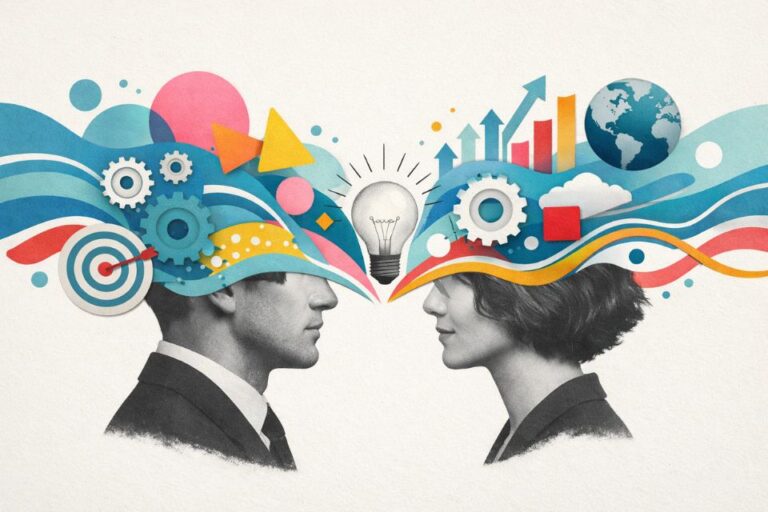

“We cannot solve our problems with the same thinking we used when we created them.” A poignant quote by Albert Einstein, a man whose face we see everywhere but whose user manual we often forget. Einstein was a hero, a visionary whose theory of relativity remains mind-boggling. But did you know he only started talking at age three and was dismissed at school as someone who would ‘never achieve anything’?
Einstein was not just brilliant; he was gifted, autistic, and had ADHD. That never-ending sense of wonder and his sometimes childlike playfulness? That was his neurodivergent brain at work.
Icons of the 'different wiring'
We constantly quote people who changed the world, often without realising that their success was inseparably linked to their neurodiversity:
-
Steve Jobs: A gifted autistic person and college drop-out. He thought like an artist in a world of technicians. Precisely because he was bullied and walked an unusual path, he could create products that not only worked but were also a joy to behold.
-
Winston Churchill: His boundless energy (working days from 08:00 to 02:00!) stemmed from his bipolarity. His ‘black dogs’ – the heavy depressions – gave him the audacity to persevere where others gave up. Not an easy colleague, but the man who changed the course of history.
-
Richard Branson: A true entrepreneur who left school early due to his dyslexia. Branson does not see his brain as a disorder but as a skill. He has made it possible for you to add dyslexic thinking as a competency on LinkedIn. “Dyslexic children should not conform,” he says, “we must encourage them to follow their dreams.”
The 'difficult' colleague Sinek
And then the man from the title: Simon Sinek. He dominates LinkedIn with his “Start with Why”. But imagine if he sat at the desk next to you. He would likely doodle non-stop during meetings to maintain his focus. He might pace restlessly, perhaps arrive late, or abruptly interrupt you with a brilliant insight that seems to come out of thin air to you.
Irritating? Perhaps. But Sinek calls his ADHD his “single greatest advantage”. It is precisely that intense hyperfocus on what truly interests him that makes him the world leader he is today. He does not hide his atypical brain; he uses it as his greatest asset.

A moment of reflection
When you look at your most valued colleague, do you primarily see their conformity to the rules, or is it actually their unique way of thinking that makes the difference for the team?
Beyond irritation, towards talent
In your team too, there are colleagues with ‘different wiring’. People who sometimes cause discomfort or frustration because they do not fit the standard mould. But what if you look beyond that irritation?
When we learn to appreciate the unique wiring of our colleagues, including the doodles and the unorthodox ideas, we make the difference between success and failure. Organisations that do not just tolerate neurodiversity but truly embrace it perform significantly better.
Do you dare to give the ‘Simon Sinek’ in your team the space they need?
Building an inclusive workplace together
When we realise that behaviour we often label as difficult, such as doodling, pacing, or unsolicited insights, is actually the expression of an engine for innovation, everything changes. Do you want to discover how to create a culture within your organisation where neurodiversity is not tolerated but utilised as a strategic advantage? Let’s spar about a brain-friendly approach that gives the Simon Sineks and Einsteins in your team the room to flourish.
Our Neurodiversity Trainings We help leaders and teams create an environment where collective intelligence is unlocked by bundling the power of different brains.
For teams: Get to know your colleagues’ user manuals and discover how to utilise each other’s unique wiring for better results.
For leaders: Discover how to look beyond frustration and build a safe haven for unorthodox talent and radical innovation.
For HR: Design your recruitment and culture so that you do not just look for the norm, but for the authentic thinkers who make your organisation future-proof.
Are you ready to unlock the untapped potential in your team?