
Introduction
We often hear from candidates who are faced with questions they simply do not know how to answer. These are frequently outdated questions that stand in the way of inclusive recruitment. Below are common interview questions that are no longer fit for purpose, along with an explanation of why they are obsolete, why they specifically fail neurodivergent talent, and what works better.
The 10 most outdated interview questions today
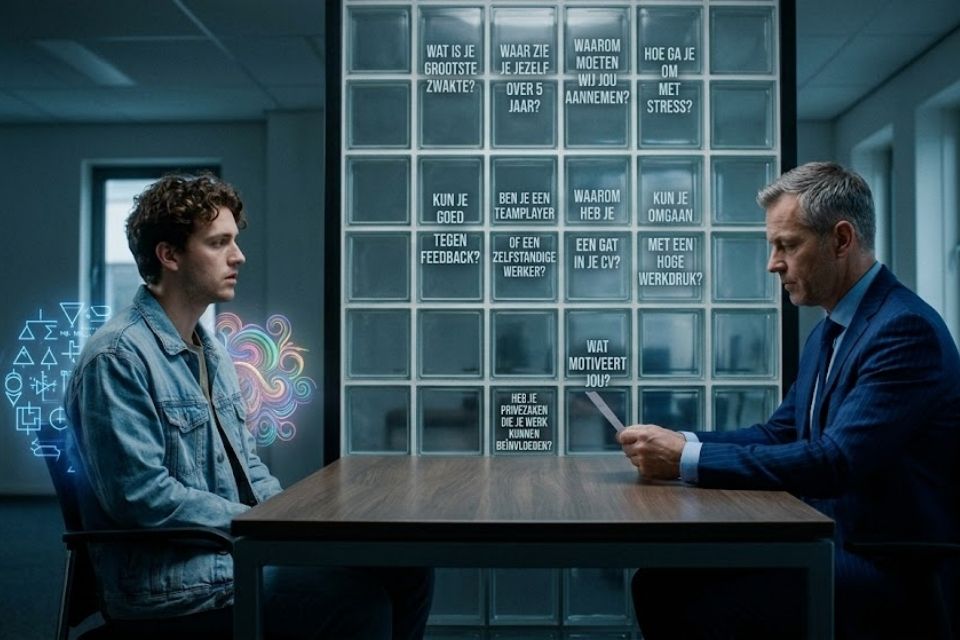
- ❌ 1. "What is your greatest weakness?"
- ❌ 2. "Where do you see yourself in 5 or 10 years?"
- ❌ 3. "Why should we hire you?"
- ❌ 4. "How do you handle stress?"
- ❌ 5. "Are you good at taking feedback?"
- ❌ 6. "Are you a team player or an independent worker?"
- ❌ 7. "Why do you have a gap in your CV?"
- ❌ 8. "Can you handle high pressure?"
- ❌ 9. "What motivates you?"
- ❌ 10. "Do you have private matters that could affect your work?"
Below you will find why each question is outdated, how it hinders neurodivergent talent, and which alternative actually works.
1. “What is your greatest weakness?”
Why it is outdated: Candidates give socially desirable answers. It says very little about a person’s actual performance and encourages acting rather than honesty.
Why this is extra difficult for neurodivergent people: Neurodivergent people have often received a lot of negative feedback and can fall into a self-critical spiral. They take the question literally and mention genuine challenges, which may be wrongly seen as being “unsuitable”. Masking (camouflaging difficulties) is implicitly rewarded.
Better alternative: “What kind of support do you need most in your work?”
2. “Where do you see yourself in 5 or 10 years?”
Why it is outdated: Careers are no longer linear. It excludes neurodivergent people unnecessarily and rewards fantasy over realism.
Why this is extra difficult for neurodivergent people: Long term abstract planning can be more difficult for those with ADHD or autism. Neurodivergent people often think more realistically and less in “career narratives”. An honest answer (“I will see what fits”) can be interpreted as a lack of ambition. Or an answer like “the boss of this company” might be seen as inappropriate (even if it is true!).
Better alternative: “What would you like to learn or develop over the next 1 to 2 years?”
3. “Why should we hire you?”
Why it is outdated: It puts the candidate in sales mode and ignores reciprocity. it creates stress rather than insight.
Why this is extra difficult for neurodivergent people: Self promotion and social positioning can be more difficult. Many neurodivergent people are factual and modest, meaning they use less “sales talk”. Stress caused by performative expectations can cause cognitive blocks.
Better alternative: “What do you need to perform well here?”
4. “How do you handle stress?”
Why it is outdated: It is too general and leads to clichés. It masks real needs.
Why this is extra difficult for neurodivergent people: Neurodivergent people often experience stress physically and sensorially. They might honestly state that overstimulation hinders them, which can be misinterpreted. The question does not invite an explanation of necessary adjustments.
Better alternative: “What are signs for you that the workload is becoming too high, and what helps at that moment?”
5. “Are you good at taking feedback?”
Why it is outdated: Almost everyone says “yes”. It ignores how the feedback is actually given.
Why this is extra difficult for neurodivergent people: Unclear or indirect feedback can be confusing. Some neurodivergent people need clear, concrete feedback. Past negative experiences with criticism can make this question very loaded.
Better alternative: “Which way of receiving feedback helps you the most?”
6. “Are you a team player or an independent worker?”
Why it is outdated: A false dichotomy. Work almost always requires both.
Why this is extra difficult for neurodivergent people: Collaboration can cost a lot of energy due to social stimuli. At the same time, they can excel in independent, deep work. The question forces a simplification of their working style.
Better alternative: “In which situations do you work best with others, and when do you prefer to work independently?”
7. “Why do you have a gap in your CV?”
Why it is outdated: Punitive and suspicious. It ignores caretaking, recovery, parenthood, or burnout. It is not relevant to current competencies.
Why this is extra difficult for neurodivergent people: Absence due to burnout, overstimulation, or a “misfit” occurs more often. They may feel they have to defend periods of recovery. It reinforces shame and stigma.
Better alternative: “Are there experiences outside of paid work that have been important for who you are now as a professional?”
8. “Can you handle high pressure?”
Why it is outdated: Implies that high pressure is the norm. It normalises an unhealthy work culture.
Why this is extra difficult for neurodivergent people: Neurodivergent people often function better with predictability and clear priorities. Structural pressure increases the risk of absence and overstimulation. Honesty about this can be wrongly seen as a lack of resilience.
Better alternative: “How do we ensure that the workload remains manageable for you here?”
9. “What motivates you?”
Why it is outdated: Too vague and produces standard answers.
Why this is extra difficult for neurodivergent people: Motivation can be strongly linked to interest, purpose, and sensory balance. They may struggle with general abstract questions. Their intrinsic motivation (e.g. deep focus) is often misunderstood.
Better alternative: “When do you notice that you are truly getting energy from your work?”
10. “Do you have private matters that could affect your work?”
Why it is outdated and problematic: Too personal and can be discriminatory. Legally it is often not allowed.
Why this is extra harmful for neurodivergent people: It can create pressure to share diagnoses or vulnerabilities. Fear of stigma can block openness. Neurodivergence is not a private problem but a form of diversity.
Better alternative: This question should not be asked at all!
The Shift
The shift you see here is from testing, checking, and selecting for a ‘perfect picture’, towards alignment, collaboration, and looking for a fit instead of a facade.

You are allowed to reframe questions, for example: “May I answer that in the context of how I function best?”
That is not being cheeky; it is a combination of self knowledge and professionalism.
Growth begins where curiosity is given space.
Understanding that neurodiversity in the workplace is not an obstacle but a source of unique talents and fresh perspectives starts at the front door: the job interview. By breaking through the facade of standard questions, you create room for authentic talent and unlock the collective intelligence of your organisation.
Would you like to explore how to make your recruitment process brain friendly and turn stigmas into opportunities? Let’s talk about an approach that looks beyond the ‘perfect picture’.
Our Neurodiversity Trainings
We help organisations, leaders, and HR professionals create a work environment where every brain can thrive.
For HR & Recruiters: Learn how to remove barriers in the selection process and recognise talent that others overlook.
For Leaders: Discover how to build an inclusive culture where psychological safety forms the basis for innovation.
For Teams: Learn to understand the unique user manuals of your colleagues to make collaboration more effective and energetic.
Are you ready for the next step?